We
were wondering just what the bus ride to Inle Lake was going to be like, given
that it costs less than $15 per person for a 10-hour ride. When we purchased
the tickets it did seem odd that the taxi fare to the bus station was
equivalent to more than half the price of the ticket, but when we discovered
that it was also an hour and a half away and realized it was farther out of
town than the airport, it made more sense.

Once
at the station, we were thankful of the driver’s knowledge and assistance, as
it is the size of a small city with tens of companies going to all known
destinations and all labeled in a script we cannot read. We were guided through
the maze of the buses, waiting areas and roadside stalls with ease by our taxi
driver and deposited immediately outside the waiting room for the company with
whom we had booked. Not only that but we were instantly met by an attendant who
found us seats in the waiting area and continually returned to check we were
OK, reconfirmed that we were in the right location and tagged and deposited 2
of our 3 bags in the bus luggage compartment when it was time to board. I had
been repeating to myself the names of the 3 significant places for this
journey, namely the final stop, the junction, at which we needed to alight and
the town on the northern tip of the lake trying to reassure myself that we
would not end up at some unknown destination, but I needed have worried. Our
luggage attendant greeted us mumbling “Inle Lake, Inle Lake.” He also flatly
refused the $1 tip we offered and before the bus departed, another official got
on the bus to reassure us that they were well aware that we that we needed to
get off at Shwenyuang junction not the final destination.
The
bus was comfortable, clean, air-conditioned and luxurious and there were even
some empty seats. Much to our surprise we even managed to get some sleep. The
one drawback was that my phone was stolen from my backpack in the stored
luggage compartment somewhere along the way. I should have known better than to
have left it in the bag, so I can really only blame myself.

In
the dim early morning light at the junction, before we had even retrieved our
bags from the bus, we had been approached by a driver hoping to secure the fare
to the nearby lakeside town of Nyuang Shwe (not to be confused with the
junction – Shwenyuang where the bus deposited us). Not 5 minutes down the road
the magical sight of the local monks’ morning alms walk greeted us. It seemed
the perfect way to begin the day and an auspicious beginning. The narrow road
into town was lined with paddy fields and we were surprised to note that the
crop was ready to harvest and newly planted in alternating rows in some
paddies. The weather makes 3 crops a year possible we are told.

Whilst
not being exactly picturesque, Nyuang Shwe has a bustling old market, a
plethora of pagodas, a monastery, a museum, several banks, a police station,
which we unfortunately had to visit, several schools and a lot of back streets
to explore, in addition to ever growing numbers of restaurants, guesthouses and
souvenir/ craft shops. It is dusty and noisy but charming, in that it makes no
pretense to be anything other than what it is. That is a prosperous and well
supplied regional centre with weaving, cane products, umbrella making, cigar
manufacture and silver adding to the abundant supply of fruit and vegetables
mostly grown on the floating gardens in the lake. It is also the hub for all of
the traveller services and accommodation and is embracing the task of providing
all that we needy travellers want with an entrepreneurial spirit, whilst
remaining essentially a village where the locals just get about their daily
business and hope to snag some of the tourist trade.

Time
has not forgotten it but progress is slow, as is evidenced by the horse carts
still plying a viable trade from the market and town. Motorcycles have arrived
and even school children can be seen riding them. All known forms of transport
compete for the available road space. Bicycles, tricycle taxis, pickup trucks
with bench seats down either side, truck sized tuk tuks similarly configured,
cars, vans, semi-trailers and even ox carts all survive on the people and
product moving trade. Out cycling on rental bikes today, we shared the road and
verges with all those types of vehicles. I delighted in noticing that the
pillion passenger on a motorcycle seems to be the self- appointed sound system
and we heard many of them singing at the top of their lungs as they sailed
along.


The
main attraction of the town is undoubtedly the lake. Of the many sights the
most publicized and charming are the traditional fishers. They use nets and
bamboo woven traps and steer their flat-bottomed boats with one leg maneuvering
the oar. All manner of other poled, paddled and motorized boats also abound and
offer a glimpse into the many varied livings that can be made in this water
zone, edged with lush vegetation. Birdlife also appears to be flourishing and
we spotted a kingfisher, egrets, herons, gulls and others we were unable to
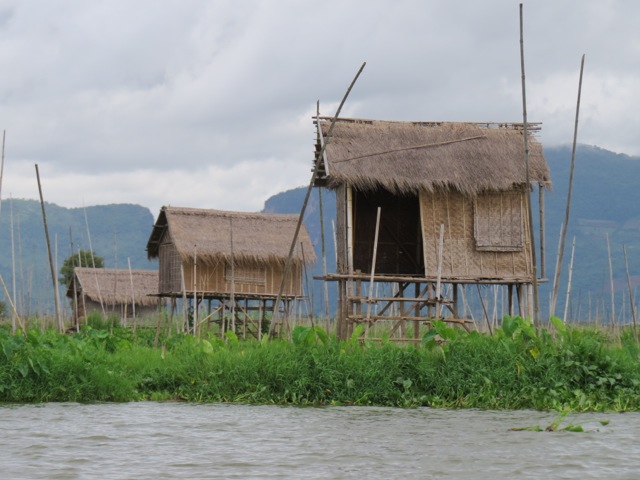
identify. Floating gardens, stilted villages and crumbling pagodas abound. I am
still pondering why these structures are labeled pagoda here but I am aware
they are known as zedi, dagoba, stupa, chorten or chedi in various other parts
of the Buddhist world. These are distinctive in that they are always in groups
rather than a single entity and seem to always have a collection of tinkling
bells attached to the very top of the spires.


I
am not thrilled at the prospect of being deposited at craft workshops with
attached shops and greeted by hoards of staff eager to sell and this is
certainly an unavoidable aspect of a boat trip on the lake, but the sales folk
were far from insistent and even in this low season willing to let us simply
look. The weaving of the area was for me the most interesting and we saw the
stems of lotus plants being handspun into fiber and woven into cloth. At $80
for a narrow scarf it was never likely to be a purchase but the process was
fascinating. It was also reassuring to see that many of the “longyis” worn
locally are produced here and are not Indian imports as we saw in Yangon. I
particularly like those that are ikat design and thought that they might be
suitable to be worn as a kira but when I tried to tie them in the Bhutanese
style I discovered that they are considerably shorter lengths.


The
four of us on our tour were able to tailor the trip to our own taste and were
given several choices about where we wanted go and what we wished to avoid. For
us that involved a longer stop at a local minority market and completely
avoiding the cigar manufacturing and monastery where monks have trained cats to
leap through hoops. Although our boatman and his accomplice spoke very little
English they were keeenly aware of what would interest us and took the trouble
to slow for us to take photos whenever our cameras appeared as well as
confirming whether or not we wanted to make certain stops.

We
remain completely enamored with Myanmar and the people.