Sunday, May 12, 2013

A walk through Monduli in the wet (a photo essay)


Right now there is an ample supply of water not that it often flows through our taps but the local environment in Monduli is verdant and tropical looking.


This is not the landscape we expected when we first came here. Africa conjured up very different images in my mind and I know that this is not the norm but having arrived in the rainy season we have been given a false impression of just how lush and green this landscape is.


I know that we should be savoring this now as it will not last but at the same time it looks exactly as it always has to me as I have never seen the dry season.


The flashes of colour that the hedge plants and flowers provide break up the seas of green that wash over the land.


Gardens are blooming and as soon as the views open up and blue skies arrive, it is hard for me to believe that it will not always look exactly like this.


With this is mind I have taken to photographing the beauty of the current scenery in the hope that the subtle changes that are barely perceptible on a daily basis will stand in stark contrast to this current impression in a few months’ time.


I suspect the main street and back streets are always going to be pretty much the same but they are still new to us and we enjoy exploring them and discovering new places. There are some unexpected contrasts in construction within just a few metres of each other


Right now the mud created when the torrential rains occur completely changes the surface of the back roads and the accessibility of everything. However within only a few hours, after the sun comes out there are dry cracked paths and it seems impossible the mud caked to our shoes could ever have existed. 


Probably the seasonal fields of flowers, we are told are being grown for their seeds will also disappear in time but right now they are spectacularly beautiful and add a welcome warmth to the landscape.


Wednesday, May 8, 2013

Teaching Poetry


Once again I am teaching poetry and once again I am feeling inept.

I actually grew to love the poetry selections in the Bhutanese curriculum and marveled at just how much of a culture that was so far removed from their own, those students could take on board. There were revelations too. The most surprising for me, being that “Ode To Autumn” made more sense to them with real life experience of an agricultural system that still largely resembled the one described in the poem in many aspects, than it ever had to Australian students. Despite the vast differences in the harvest described, they could see its beauty, relate to its images and understand its message.

Here and now, I am grappling with African poets about whom I know nothing while the students grapple with a fear and loathing of poetry, born from the difficulties of the exam questions, routinely asked. I had cause for celebration when I realized that the vast majority of poems in the anthology, we are using are African and there are only a few outstanding exceptions, which are well worthy of inclusion, in my humble opinion. I have found again that any poem can easily be enjoyed by someone with an open mind and a willingness to think beyond their own limited world experience. When there is an opportunity to step back and simply see what they do understand and can interpret, they amaze themselves and me. When guided through deliberate and careful questioning, in the secure environment of group discussion they are capable of analysing with astute clarity and derive real pride from the achievement.

“Why are the exam questions then so ornery?” I ask myself. Should the system be designed to weed out the least discerning or expose the hidden knowledge, abilities and talents of students? Luckily I am the writer of the end of term exams but unfortunately I am once again bound by the need for them to pass national exams with those ornery questions! At least the classroom practice can be of my own making.

Again the students are discovering that they enjoy the writing process and attempting their own poetic compositions. Many even delight in sharing their creations in the classroom context. While the pressure to complete the course work once again dominates the schemes of work and lesson plans that we teachers devise, the deviation into a little creative input from the students is a welcome relief for both them and me.

The imagery which spills easily from their pens in their desperate attempts to incorporate the literary devices we have studied, shout Africa and remind me how little we have seen or really know about this vast continent.

Once again there is so much for me to learn and yet again I wonder if I am teaching the students as much as they are teaching me….

Thursday, May 2, 2013

oNe PhOtO a DaY fOr ApRiL


THE PROMPS FOR THE MONTH


1 PLAY: still able to play in the dirt with nothing but their imaginations to inspire them, but a funny looking white woman is a definite distraction!


2 BLUE: An iridescent blue-shouldered, white –bellied sunbird against a pale blue African sky.


3 SOMETHING BEGINNING WITH A: A is for Arusha with its landmark clock tower.


4 THIS HAPPENED TODAY: at the one and only set of traffic lights in Arusha where almost anything goes in traffic terms.


5 SOMETHING GOOD: only goats could think that these scary thorn bushes were something good to eat!


6 AIR: open air butchers in Monduli Juu


7 DREAMY: Such a dreamy look in her eyes- What are her aspirations?


8 ON YOUR PLATE: Chipsi MaYai local treat of an omelette made with chips


9 TINY: This 2-day old kid born prematurely on the school campus is tiny


10 A PLACE: a place we see daily from behind the library, but have yet to walk to.


11 DETAIL: the detail of the mud we struggle through everyday to get to school


12 IN THE MIDDLE: in the middle of the journey to school today we had to stop to rebuild the road where it had washed away overnight.


13 VIEW FROM YOUR BED: the mosquito net we use every night


14 WATER: The water tank that services the 2 volunteer houses and 6 volunteers- note the rock to stop drips and the ingenious stitch and melt repair.


15 ALONE: This African grass owl was discovered in the library all alone – was it perhaps reading up to add to its wisdom?


16 YOUR FAVOURITE COLOUR: These orange birds were the first to catch my attention because orange is my favourite colour.


17 BUSY: Orkeeswa students busy repairing chairs in the “fix it” activity


18 HELLO! One doesn’t need language to know what these kids are calling out as we pass. 


19 BUTTON: This ‘button is pinned to the notice board in our arts faculty staffroom


20 ON YOUR MIND: My home class XC in Bhutan in 2011 and 2012. They are often on my mind. I miss them and wonder where life has taken them

21 FIRE: the cooking fire and the dinner being prepared on it at one of our student’s bomas yesterday


22 BLURRY: Andrew’s blurry hand as he defeats the students at cards, yet again in activity time- I love that the headmaster is also watching on from the doorway


23 TIME: to build nests, feed the young and welcome them into this weaverbird community in a large tree outside the Form 4 classroom!


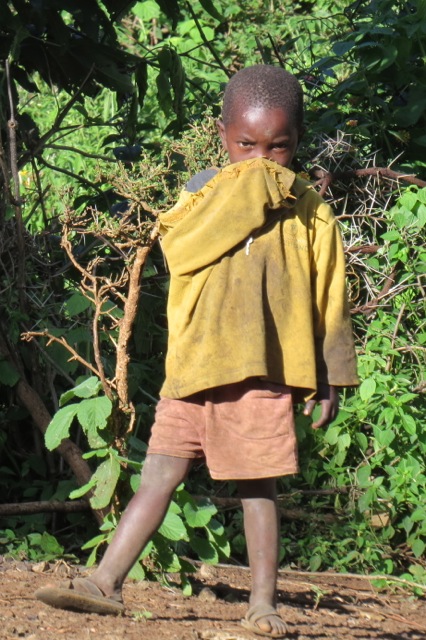
24 I SAW THIS PERSON TODAY: While visiting a student at her home I saw her shy little brother watching us but too afraid to join us


25 LIFE IS …….. all about “ugali”( the white stodge) - a rather unappetizing maize staple served twice a week as school lunches and eaten much more often than that by the locals!


26 CHILDHOOD: is not always smiles and laughter especially when it is happening to you- little Sophie


27 EARTH: African Earth after just 3 days without rain the mud has turned to this cracked and parched surface already


28 MY SUNDAY: Watching Suzi dress Melanie in a Maasai Shuka


29 I WORE THIS TODAY: and almost every day for the last 4 months : the memories attached make it hard to remove


30 GLASSES: I could never read, teach or hike without this 3 pack of glasses (displayed on a beautiful Maasai Shuka)

This is the summary for April.

Please feel free to comment if you have a favourite or a question about any of these images